



You can speak English well and still feel confused in Australia when someone says, “Grab a coldie from the bottle-o this arvo.” Aussie slang can sound like a different language at first.
That is because Australians often shorten words, use playful expressions, and speak casually in daily life.
This guide explains 100 Australian slang words and phrases, with meanings and examples, so you can understand locals with more confidence.
Whether you are visiting Australia, studying here, working here, or preparing for IELTS, learning common Aussie slang can help you feel more comfortable in real conversations.
What is Aussie slang?
Aussie slang, also called Australian slang, is informal English commonly used in Australia. It includes shortened words, nicknames, sayings, and casual expressions such as mate, no worries, arvo, and brekky.
You will hear Aussie slang in everyday conversations, shops, workplaces, universities, and social settings across Australia.
100 Australian Slang Words & Phrases (2026 guide)
Aussie slang word/phrase | Meaning |
|---|---|
A Cold One | Beer |
Arvo | Afternoon |
Aussie Salute | Wave to scare the flies |
Avo | Avocado |
Bail | To cancel plans |
Barbie | Barbecue |
Bathers | Swimsuit |
Beauty | Great! |
Billabong | A pond in a dry riverbed |
Billy | Teapot (in the outback on the fire) |
Bloody | Very |
Bloody oath | Yes! Or “That’s very true” |
Bludger | Someone who’s lazy |
Bogan | Someone who’s not very sophisticated |
Booze Bus | Police vehicle used to catch drunk drivers |
Bottle-O | Liquor shop: a place to buy alcohol |
Brekky | Breakfast |
Brolly | Umbrella |
Budgie Smugglers | Speedos |
Bush | “Out in the bush” or away from civilisation |
Choc A Bloc | Full |
Biccy | Biscuit |
Chook | Chicken |
Chrissie | Christmas |
Cobber | Very good friend |
Coldie | Beer |
Coppers | Policemen |
Crikey | an expression of surprise |
Crook | Being ill (I’m crook); a criminal (he’s a crook) |
Dag | Someone who’s a bit of a nerd or geek |
Daks | Trousers |
Deadset | That’s true, or true! |
Defo | Definitely |
Devo | Devastated |
Drongo | a Fool, ‘Don’t be a drongo mate’ |
Dunny | Toilet |
Durry | Cigarette |
Esky | An insulated container that keeps things cold |
Facey | |
Fair Dinkum | Honestly? Or, Yes honestly! |
Flannie / Flanno | flannelette shirt |
Flat out | Really busy |
Footy | Football (AFL / Aussie Rules) |
G’day | Hello |
Galah | Not being bright, also a stupid person |
Gnarly | Awesome |
Going off | Busy, lots of people |
Good On Ya | Good work |
Goon | Wine in a box |
Hard yakka | Hard work |
Heaps | Loads, lots, many |
Hoon | Hooligan or a very bad driver |
Iffy | Bit risky or unreasonable |
Knickers | Female underwear |
Lappy | Laptop |
Larrikin | Someone who’s always up for a laugh |
Lollies | Sweets |
Maccas | McDonalds |
Manchester | Sheets / Linen etc |
Mate | Friend |
Mozzie | Mosquito |
No Drama | No problem / it’s ok |
No Worries | No problem / it’s ok |
No Wucka’s | A truly Aussie way to say ‘no worries’ |
Outback | The interior of Australia. Even more remote than “the bush” |
Pash | To kiss |
Pissed Off | An offensive/vulgar way of saying you are very annoyed |
Piss Up | A party, a get together and in Australia |
Pissed | Intoxicated, Drunk |
Piss Off | An offensive way to tell someone to go away or get lost. |
Rack Off | The less offensive way to tell someone to go away or get lost. |
Reckon | For sure |
Rellie / Rello | Relatives |
Ripper | ‘You little ripper’ = That’s fantastic! |
Rooted | Tired or Broken |
Runners | Trainers, Sneakers |
Sanger | Sandwich |
Servo | Service Station / Garage |
Sheila | A woman |
Sick | Awesome; ‘that’s really sick mate’ |
Sickie | A sick day off work |
Slab | A carton of beers |
Snag | Sausage |
Stoked | Happy, Pleased |
Straya | Australia |
Stubby | A bottle of beer |
Stuffed | Tired |
Sunnies | Sunglasses |
Swag | Single bed you can roll up, a bit like a sleeping bag |
Tea | Dinner |
Tinny | Can of beer or small boat |
Thongs | Flip Flops |
True Blue | Genuinely Australian |
Tucker | Food |
Two Up | A gambling game played on Anzac day |
U-IE | To take a U-Turn when driving |
Up yourself | Stuck up |
Woop Woop | Middle of nowhere “he lives out woop woop” |
Ya | You |
Yous | Plural of you |
Read stories from 8 people who failed to understand an Aussie slang expression.

What do common Australian slang words mean in a sentence?
When you’ve read the list of most common Australian slang words, or true-blue Aussie slang, you’re well on your way to understanding your Aussie mates. If you want to use slang correctly, check out the following examples.
What does “no worries” mean in Australia?
“No worries” means it is okay, don’t worry about it, sure thing, or you’re welcome. It is one of the most common Australian phrases you will hear.
If you apologise after bumping into someone on the train, they might smile and say, “No worries.” If a coworker asks for help, you can also reply, “No worries.” It is friendly, relaxed, and very Australian. Just remember, people say no worries, not no worry.
What is the difference between bush, outback, and woop woop?
The bush usually means rural natural areas outside the city. The outback means remote inland parts of Australia. Woop woop is a funny way to say somewhere far away.
Think of it like this. You might drive from the city to the bush, then further into the outback. If someone says, “He lives out woop woop,” they mean he lives far away from everything. Usually somewhere that feels hard to get to.
What does “coldie” mean in Australia?
A coldie means a cold drink, often a cold beer. It is usually used in casual social settings.
If someone says, “Want a coldie?” they are offering you a drink. On a hot Australian day, that word comes out a lot.
What does “slab” mean in Australia?
A slab usually means a full carton or box of beer cans or bottles. It is something people buy for gatherings or barbecues.
You might hear, “I’ll grab a slab for tonight.” That means they are bringing drinks for the group.
What is a “bottle-o” in Australia?
A bottle-o is a liquor store or bottle shop where people buy alcohol. Australians love shortening words, so bottle shop becomes bottle-o.
Example: “I’m stopping by the bottle-o on the way home.”
What is a “booze bus” in Australia?
A booze bus is a police vehicle used for roadside alcohol testing. It checks drivers for drink driving.
Australia takes road safety seriously, so if someone warns you about a booze bus, they mean police testing may be nearby.
What does “Straya” mean?
“Straya” is a playful way some Australians say “Australia” in fast casual speech. It is often used jokingly or with national pride.
You may hear it online, at barbecues, or during sporting events. It is more about tone and humour than formal language.
What is “Straya Day”?
“Straya Day” is an informal nickname some people use for Australia Day on 26 January. It is casual slang, not the official name.
You may hear it when people talk about public holidays, beach trips, backyard barbecues, or spending time with family and mates.
What does “true-blue” mean in Australia?
“True-blue” means genuinely Australian, loyal, or authentic. It often describes people, food, traditions, or attitudes.
If someone says, “That’s a true-blue Aussie meal,” they mean it feels classic and proudly Australian.
What does “tucker” mean in Australia?
Tucker means food. It is an old but still recognised Australian slang word.
You might hear, “Let’s get some tucker before we head out.” It simply means let’s eat.
What does “snags on a barbie” mean?
“Snags on a barbie” means sausages cooked on a barbecue. It is one of the most iconic Aussie food phrases.
A snag is a sausage. A barbie is a barbecue. Put them together and you have a very Australian weekend meal.
What does “relos or mates” mean?
Relos means relatives or family members. Mates means friends.
If someone says, “We’re having the relos and mates over,” expect a full house, lots of food, and plenty of chatting.
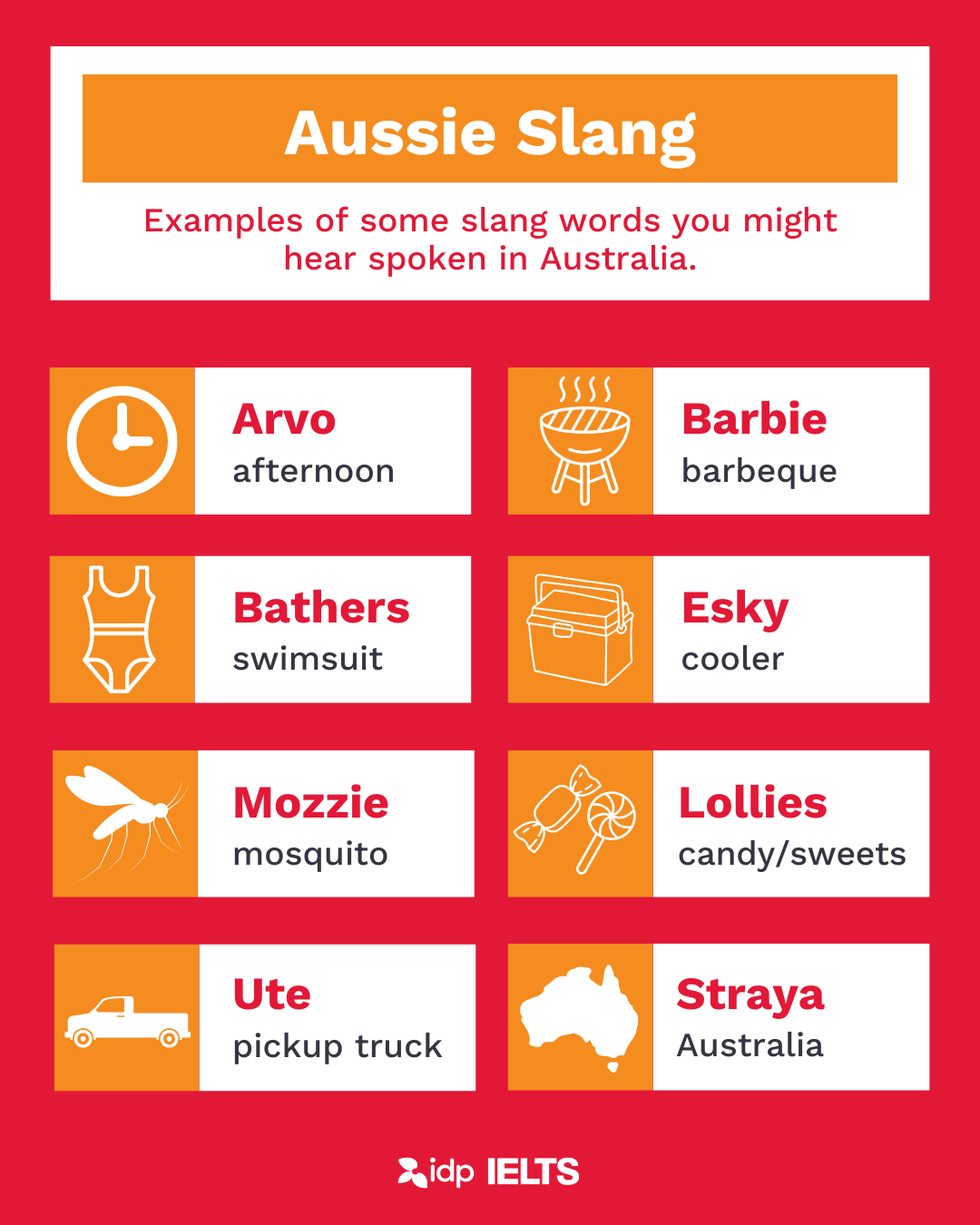
The infographic above shows a list of common Aussie slang words and their meanings.
Modern slang words used in Australia in 2026
Some internet slang is also common in Australia, especially among younger people.
Slang | Meaning |
|---|---|
Cooked | Bad situation / exhausted / wild |
Delulu | Delusional |
Rent free | Constantly in your mind |
Lowkey | Quietly / secretly |
Highkey | Openly / strongly |
NPC | Someone acting robotic or basic |
Can I use idioms and jargon in the IELTS Writing and Speaking test?
The IELTS Speaking test is supposed to represent a normal conversation between two people. So, you should avoid very formal language. For example, you don’t usually “furthermore” or “moreover” in every-day conversations. However, you probably also don’t want to use overly informal language. Some slang is probably too informal: if you tell your examiner “my friend threw me some shade,” he or she may not understand what you mean.
You can get a higher IELTS band score if you show the ability to use idiomatic expressions appropriately but perhaps stick with common idiomatic expressions that are well-known. We’ve provided some helpful lists with our Idioms A-Z: Explained.
Ready to book your IELTS test?
Achieve your visa, work, and study goals with IELTS. Find your closest test centre and book your test now.